Generative AI refers to a category of artificial intelligence systems designed to create new content rather than simply analyse existing data. These systems can generate text, images, code, or insights based on patterns learned from large datasets. In the context of electricity distribution network management, Generative AI primarily supports content creation, knowledge work, documentation, and decision support for human experts. It can help synthesize information, assist with reporting, training, and operational analysis, and improve overall productivity. However, Generative AI is not intended for autonomous grid control or for making high‑impact decisions independently.
Highlights
According to Bloomberg Intelligence, the generative AI market is expected to reach around $1.3 trillion by 2032, accounting for 10–12% of global technology spending. Valued at about $40 billion in 2022, the market rose to roughly $64 billion in 2023, driven by rapid adoption across software, infrastructure, and enterprise use cases. This acceleration is best illustrated by ChatGPT. Launched in November 2022, it reached one million users in five days, becoming the fastest‑growing consumer application ever. Adoption has continued at scale, with several hundred million weekly active users globally by 2025–2026, signaling the mainstream uptake of generative AI. On the regulatory side, the EU AI Act, adopted in 2024, is the world’s first comprehensive AI regulation. It introduces specific transparency and risk‑management obligations for generative and general‑purpose AI models, with key provisions beginning to apply in 2025 and full enforcement extending into 2026. (EU AI Act: first regulation on artificial intelligence).
Challenges and opportunities for DSOs
Opportunities:
- Enhance employee productivity across DSO processes as Generative AI has the potential of automating routine, repetitive content related tasks and augmenting work activities that require problem-solving and abstract reasoning skills.
- Support personal experiences: generative AI can tailor content, products, and services to individual preferences for DSO customers, partners and employees.
- Automate human-like content creation, support informed decision making and augment human creativity across DSO processes.
- Augment software development.
- Ability to support DSO decision‑making by synthesizing information across data sources, domains, and perspectives, helping experts explore options, assess implications, and align stakeholders in complex planning and operational contexts.
Challenges:
- The use of generative AI will require specialised resources and adapted validation processes (bias/accuracy monitoring, privacy and security management) before establishing confidence in processes critical to the distributor.
- Data quality: Generative AI relies on high quality training and input data (e.g. grid data)
- Intellectual property: information entered in Generative AI services can become part of its training set, determining ownership of content created by GenAI is complex.
- The adoption of Generative AI introduces governance challenges that go beyond technology, including the need for robust validation arrangements, clear accountability for AI outputs, and explicit policies on data usage and intellectual property. Without such governance in place, Generative AI cannot be safely applied in DSO‑critical processes.
E.DSO Considerations
- This type of artificial intelligence was popularised later than predictive AI and has therefore experienced more recent adoption and success. As a result, Generative AI can be considered a fast‑emerging technology, currently in the pilot or early‑adoption phase, with significant impact expected in the short to mid term.
- Generative AI solutions performances are directly based on data availibility and quality and emphasize data privacy concerns.
- Generative AI algorithm performance control requires special attention and dedicated monitoring tools.
- Generative AI technologies require specific skills and companies will have to develop specific training programs.
- Development and implementation of Generative AI solutions must be carried out with the aim of reducing their carbon footprint.
- Particular attention must be paid to the ethical aspect of Generative AI (potential concerns about justice, fairness, accountability etc.)
- It will be necessary to ensure that the results of generative AI are always identified as being generated by a machine.
- For decisions with high operational or safety impact, Generative AI should be used strictly as a supporting tool, with human oversight as a mandatory requirement rather than an optional control.
- Even when final decisions remain with humans, Generative AI can significantly influence how problems are framed and options are assessed, which makes consistent governance and transparency across DSO processes essential.
Potential use cases
- Improve knowledge management: retrieve stored internal knowledge for better-informed decisions across DSO processes, clarify complex regulations etc.
- Boost grid management and operations by automating & augmenting tasks: incident planning & response, network development studies, grid engineering, asset performance & planning, demand load forecasting, network control, etc.
- Enhance customer experience by generating personalised content, recommendations, and automating responses to customer requests.
- Faster product- and software engineering: creating novel designs, prototypes, code and testing these.
Ongoing projects
Stedin:
- Stedin is advancing Generative AI capabilities through scalable, responsible, and high-impact adoption, including the development of capabilities to safely operationalise advanced AI systems such as monitoring, evaluation, and compliance. In parallel, Stedin enables organisation-wide adoption via shared building blocks like a standardized RAG (Retrieval-Augmented Generation) template and a GenAI Gateway, ensuring consistent, secure, and governed integration of LLMs. At the same time, Stedin focuses on high-impact use cases, such as AI-driven validation of contractor quotations to detect inconsistencies or unjustified costs, improving the quality and reliability of agreements between Stedin and its partners.
ČEZ Distribuce:
- Proof of Concept including dedicated implementation of OpenAI based generative AI model as a chatbot for connection requirements information prepared for customers and tested by internal employees. Next steps would be to integrate chatbot in public website, analytics of Customer’s feedback, internal chatbot for corporate documentation, HR onboarding etc.
UFD:
- UFD, its working on two projects to leverage generative artificial intelligence. Both projects are similar and aim to provide our Call Center and Control Room Operators a co-pilot to support their activity and personalise responses to customer calls and incidents, respectively.
- Additionally, it is planned to use AI as a simple manager for advanced queries to the repository of information available in the cloud, offering a unique and straightforward result.
ORES:
- As part of a pilot project, generative AI will be used to optimally estimate the baseline calculation model to be assigned to a network user in order to assess flexibility services. For each specific case, the output will specify the formula to be applied to achieve both technical and economic efficiency, while also preventing fraudulent behaviors (such as “gaming” across multiple markets simultaneously).
Link to related E.DSO success cases
| Success case number | Title | Company |
| 20.2025 | Cartoline | Enedis |
| 4.2024 | DeepGourboGen | Enedis |
Impact on the energy system
Improved decision making support and coordination.
Time to scale
0-5 years.
Link to relevant EU policies
Digitalisation, Data sharing, Cybersecurity (NIS2), Flexibility, EU AI act.
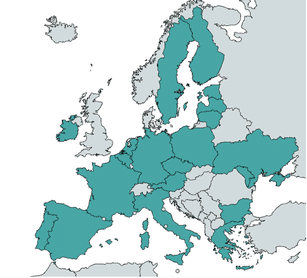
Technology deployment across countries with E.DSO members
Last update: 12 September 2026